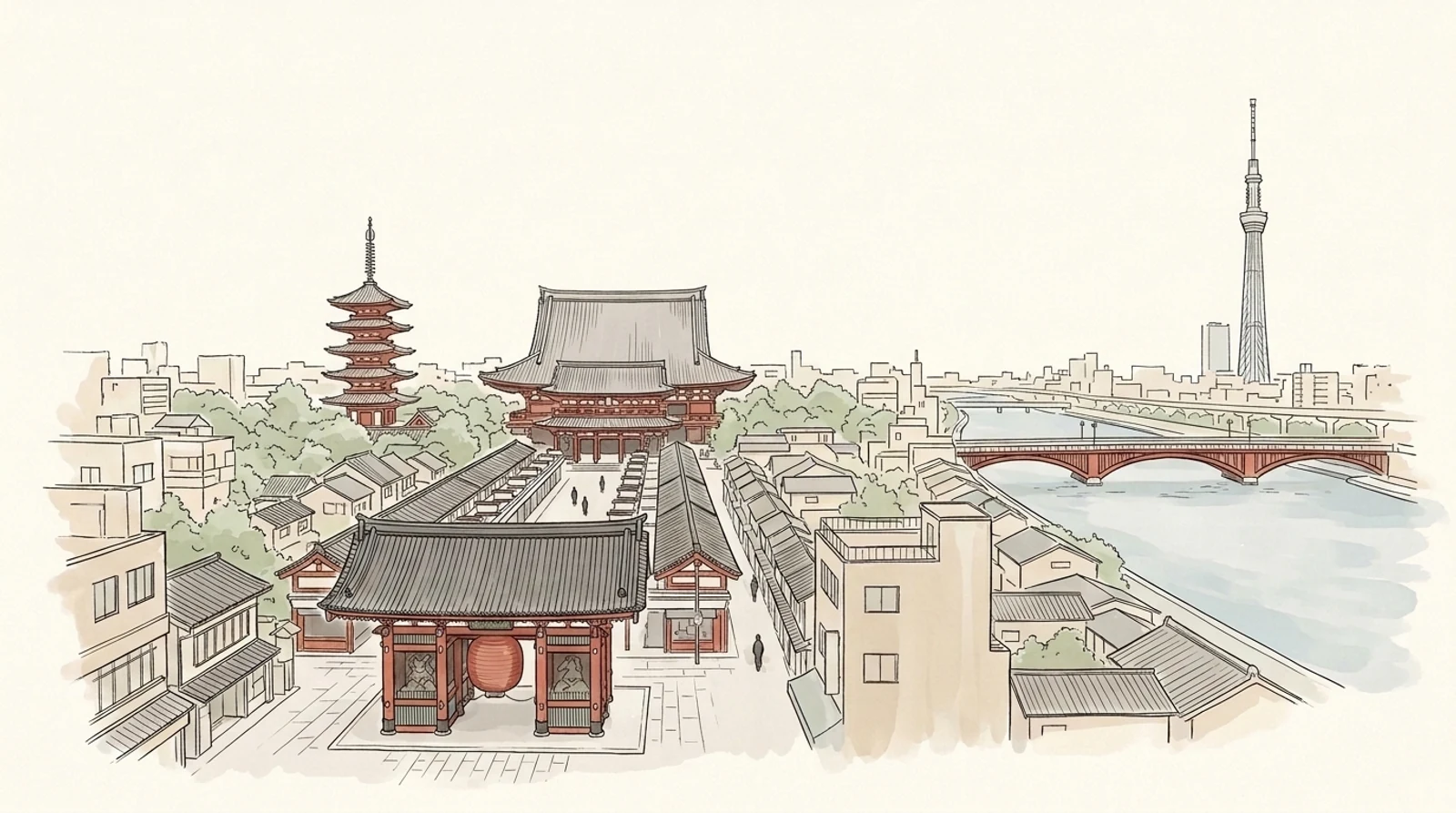
Asakusa travel guide: a local's tips for Senso-ji and more
Visit Senso-ji early in the morning or after dark, when the crowds thin and the buildings are lit until about 11 p.m. Half a day covers the temple, Nakamise and the Skytree view from the river; add Kappabashi or Hoppy Street if you have longer. Most sights are free and within a 15-minute walk.
I’m a Japanese local and I’m in Asakusa about once a week. This page is the short version of what I’d tell a friend visiting for the first time.
When should you visit Asakusa?
Early morning or after dark. Those are my two favorite times at Senso-ji. In the morning there are far fewer people; at night the main hall, pagoda and gates are lit from sunset until about 11 p.m. Midday, especially on weekends, is when it is most crowded.
- Senso-ji main hall: 6:00–17:00 (from 6:30 October–March), free
- Light-up: sunset to about 23:00, every night
How do you get to Asakusa?
Asakusa Station is served by the Ginza Line, the Toei Asakusa Line and Tobu trains; Senso-ji is about 5 minutes on foot. The Tsukuba Express also has an “Asakusa” station, but it is a separate station about 500 m west — handy for Kappabashi.
With a suitcase, use Ginza Line Exit 1, which has a street elevator; Tokyo Metro’s Japanese barrier-free page lists one step-free route down to Platform 1. Asakusa Station has the details for every line, and Asakusa luggage storage covers lockers and where to leave a suitcase.
Coming from the airport? Narita and Haneda to Asakusa compares the direct trains, the Skyliner, buses and taxis. Still choosing a hotel? Where to stay in Asakusa compares five bases by train line and airport time. Riding the subway a lot? Is the Tokyo Subway Ticket worth it? does the maths from Asakusa.
What should you see?
- Kaminarimon and Nakamise — the famous gate and the shopping street to the temple.
- Senso-ji — Tokyo’s best-known temple, with the five-story pagoda and Asakusa Shrine next door.
- The Skytree view from Azuma Bridge — free, any time of day; walk along the river for different angles.
- Asakusa Culture Tourist Information Center — free 8th-floor terrace (open until 22:00) looking down Nakamise.
- Kappabashi Kitchen Town — if you cook, go to Iidaya. I could spend an hour there.
Short on time? Follow my 2-hour Asakusa walking route. Want to walk it in kimono? The kimono rental comparison lists prices and return times. Prefer to ride? Asakusa rickshaw prices compares Ebisuya and Jidaiya.
Where should you eat?
On Nakamise, eat your way up the street — three or four snacks at around ¥500 each (street food in Asakusa has five shops and where to eat each one). For drinks with a crowd, walk through Hoppy Street, the lane of open-air izakaya west of the temple. For a sit-down lunch, our tonkatsu guide compares five pork-cutlet specialists near Kaminarimon, and our soba guide does the same for five buckwheat-noodle shops. For thick wheat noodles, our udon guide compares three shops within 3 minutes of Kaminarimon. For sushi, our sushi guide compares five independent shops, from a ¥1,650 lunch to Edo-style sushi since 1866; for something sweet, see matcha desserts in Asakusa. If you don’t eat meat or fish, see our vegan and vegetarian guide; for halal food and prayer rooms, see halal food in Asakusa. For a quick, cheap meal, our onigiri guide compares five rice-ball shops. Curry fans: see our curry guide.
What should you skip?
My honest advice: skip the wagyu steak restaurants aimed at tourists. You came to one of Tokyo’s oldest neighborhoods — eat what the locals eat here.
What’s on in Asakusa?
- Tori-no-ichi 2026 — November 7 and 19, the rake fair at Otori Shrine. Go at night.
- Hagoita-ichi 2026 — the battledore fair at Senso-ji in December.
- Hatsumode 2027 — the first shrine and temple visit of the New Year at Senso-ji.
Getting around on foot
Everything on this page is within about 15 minutes’ walk of Senso-ji. Comfortable shoes beat any pass or ticket.