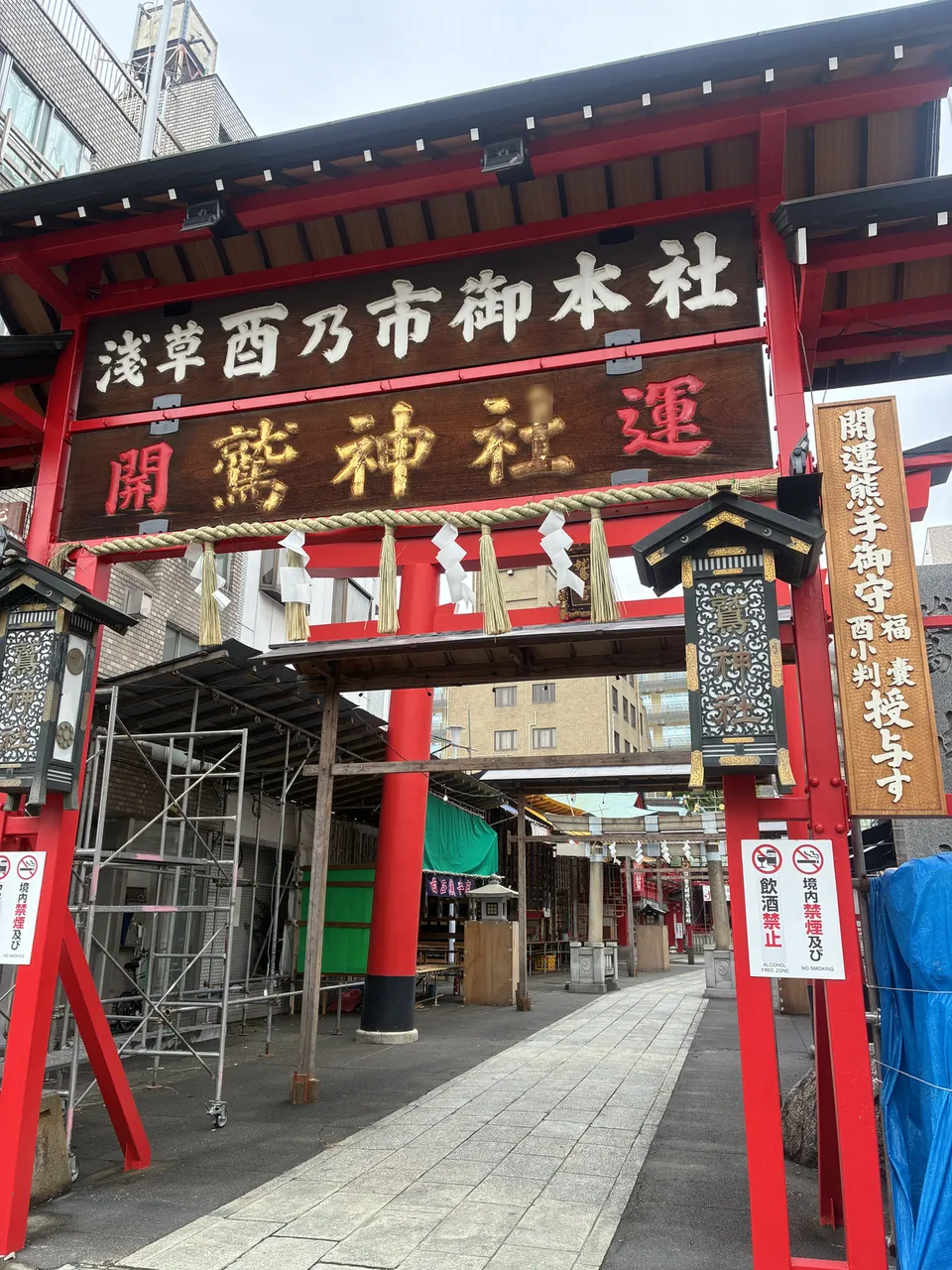
Otori Shrine, Asakusa: home of the Tori-no-ichi rake fair
Otori Shrine is the home of Tori-no-ichi, the November fair where Tokyo shops buy lucky bamboo rakes; in 2026 it falls on November 7 and 19. On ordinary days it is a free, quiet neighborhood shrine worth 15 minutes for the nade-okame mask. Iriya Station is 7 minutes away.
Quick facts
- From Iriya Stn
- 7 min from Exit 3 (Hibiya Line)
- Other stations
- Tsukuba Express Asakusa 8 min; Ginza Line Asakusa about 15 min
- Step-free
- Iriya has a street elevator but no step-free route to the platforms
- Time needed
- 15 min on an ordinary day
- Address
- 3-18-7 Senzoku, Taito-ku
“They were getting ready for Tori-no-ichi. I think a lot of people will come in November.”
What is Otori Shrine?
Otori Shrine (鷲神社, Otori Jinja), known locally as Otori-sama, is the shrine behind Tori-no-ichi, the November rake fair. In the Edo period it was called Washi Daimyojin-sha and took its present name in the early Meiji era. It enshrines two gods, Amenohiwashi-no-mikoto and Prince Yamato Takeru (Taito City).
The shrine’s story is that Yamato Takeru, on his way home from campaigning in the east, hung a rake (kumade) at a small shrine here to celebrate his victory. That day was a rooster day in November, and it became the festival day (Taito City).
When is Tori-no-ichi in 2026?
On Saturday, November 7 and Thursday, November 19, 2026 — the two rooster days of the month (torinoichi.jp). The fair runs through the night, and the streets around the shrine fill with stalls selling decorated rakes. For timings, crowds and how rake buying works, see the full guide: Tori-no-ichi 2026.
The rakes started as plain farm tools sold at a harvest market. Later they became charms said to “rake in” luck and money, which is why shop owners still buy one every year (Taito City). Taito City also notes that Asakusa’s fair grew busy because Senso-ji, the Yoshiwara and the Saruwaka-machi theaters were all nearby.
What is there to see on an ordinary day?
Not much beyond the hall and the nade-okame: a large mask of Okame, the smiling goddess, in front of the worship hall. You stroke the part of her face that matches your wish (shrine website):
- forehead: wisdom
- eyes: foresight
- nose: money
- the cheek on your right as you face her: love
- the other cheek: health
- mouth: protection from bad luck
- chin, stroked clockwise: things turning out well
The shrine notes that the nose gets the most strokes, with the love cheek close behind. Since 2015 the mask is not on show during the fair, to avoid accidents in the crowd; outside fair days it stays at the front of the hall as before.
When I walked past on October 30, 2026, the shrine was getting ready for Tori-no-ichi, with scaffolding going up at the gate. I think a lot of people will come in November.
Outside November this is a quiet local shrine, so treat it as a stop on a walk, not a destination. The Oku-Asakusa walk links it with the Yoshiwara sites a few minutes east.
What is Chokokuji next door?
Chokokuji (長國寺, 3-19-6 Senzoku) is a Hokke-shu Buddhist temple right beside the shrine. It holds its own Tori-no-ichi on the same days, calls itself “the temple of the rooster” and runs the official fair site, torinoichi.jp.
Getting there
- Iriya Station (Tokyo Metro Hibiya Line): about 7 minutes from North Exit 3. Tokyo Metro lists a street elevator but no step-free route between the street and the platforms.
- Tsukuba Express Asakusa Station: about 8 minutes.
- Asakusa Station (Ginza Line, Tobu): about 15 minutes. Ginza Line Exit 1 has a street elevator (Tokyo Metro).
- Taito City “Megurin” community bus (South Megurin) also stops nearby, according to the shrine.
Times are the shrine’s own (access page).
Nearby
Yoshiwara Benzaiten and Yoshiwara Shrine are about 5 minutes east (est. from map distance), on the site of the old licensed quarter. Asakusa Fuji Sengen Shrine, the Mount Fuji shrine, is about 12 minutes south (est.). Walk south about 15 minutes (est.) and you are back at Senso-ji. For the bigger picture, start with the Asakusa travel guide.