Yoshiwara Shrine and Benzaiten: the old licensed quarter
Three small sites a few minutes apart are what remain of the Yoshiwara, Edo's licensed red-light quarter (1657–1958): Yoshiwara Shrine, the Benzaiten shrine with its 1923 earthquake memorial, and the willow and lamp at the old gate. Free; allow 30 minutes in daylight. The shrine office opens 10 a.m.–4 p.m.
Quick facts
- Shrine office
- 10:00–16:00 (Jan 1–7 until 18:00)
- From Minowa Stn
- 15 min walk (Hibiya Line)
- Step-free
- Iriya has a street elevator but no step-free route to the platforms
- Time needed
- About 30 min for all three sites
- Addresses
- Shrine 3-20-2, Benzaiten 3-22-3, willow 4-10-8 Senzoku
What was the Yoshiwara?
The Yoshiwara was the only red-light quarter in Edo licensed by the shogunate. It opened in 1617 near today’s Nihonbashi Ningyocho and, after the Great Fire of Meireki in 1657, was moved out here to Senzoku. It was closed in 1958 under the Anti-Prostitution Act (Taito City).
For three centuries it was a source of Edo fashion, prints and literature. It was also a place of confinement. The women who worked there were bound to the houses under indentured contracts and were forbidden to leave the quarter (Nihon Dai Hyakka Zensho, on Kotobank). The quarter had one way in and out, the great gate (Omon), with a guard post beyond it that watched who came and went, women above all (Taito City). The quarter’s old street names, such as Edo-cho and Kyo-machi, lasted until the address changes of 1966 (Taito City).
There is little to see today. The three sites below are what is left.
Yoshiwara Shrine
The shrine (吉原神社) brings together the quarter’s guardian gods. The Yoshiwara had five small Inari shrines: one in front of the gate and one at each of its four corners. In 1881 they were merged as Yoshiwara Shrine. The building burned in the 1923 earthquake; in 1934 a new hall went up on the present site and the Benzaiten of the nearby pond was enshrined with them. That hall burned in the 1945 air raids, and the current one dates from 1968 (shrine website).
Today the shrine lists six deities and their blessings. Kurosuke Inari, which a 1768 account quoted by the shrine credits with ending a famine, is worshipped for matchmaking. The annual festival runs for three days from the third Friday of May, with a portable shrine carried through the streets on the Saturday evening.
- Shrine office: 10 a.m.–4 p.m., until 6 p.m. January 1–7 (shrine website).
Yoshiwara Benzaiten and the Hanazono pond
About two minutes south (est.) is Yoshiwara Benzaiten (吉原弁財天, 3-22-3 Senzoku), on the site of the Hanazono pond. Part of the marsh was left as a pond when the quarter was built, and a small Benzaiten shrine on its bank was worshipped by the house owners. It is now one of the Asakusa Seven Lucky Gods, busy in early January (Taito City).
In the Great Kanto Earthquake of 1923, people fleeing the fires crowded into the grounds. Taito City records that 490 drowned in the pond. The shrine says about 500 lost their lives here, to fire or to the water. A large Kannon statue was put up on the mound in June 1926 as a memorial, prayers are offered there daily, and a memorial service is held every September 1 (shrine website). The pond was filled in from 1959 for a telephone exchange building, leaving only a trace (Taito City).
The small Benzaiten hall was repaired by volunteers in 2012, and Tokyo University of the Arts students painted a mural across its walls (shrine website). A stone of 1960 nearby, the Hana-no-Yoshiwara nagori-hi, records the quarter’s history (Taito City).
Mikaeri-yanagi and the Omon gate
Walk about 5 minutes (400 m, est.) northeast to the Yoshiwara-Omon crossing. The willow there is the Mikaeri-yanagi, the “looking-back willow” (4-10-8 Senzoku). Visitors leaving the quarter were said to turn here for a last look. It once stood on the embankment by the Sanya canal; road works moved it, and fire, earthquake and war meant it has been replanted several times (Taito City).
From the willow, Gojukken-dori curves in an S toward the old gate. The bend kept the quarter out of sight from the embankment road. The publisher Tsutaya Juzaburo, who discovered Utamaro and Sharaku, opened his bookshop Kosho-do on this street in his twenties (Taito City’s Tsutaya Juzaburo page).
The Omon itself burned in the 1923 earthquake and was never rebuilt. A street lamp shaped like its posts, lettered “Yoshiwara Omon”, marks the spot (Taito City). The lamp and the willow are all there is to see.
Getting there
Yoshiwara Shrine’s own access note gives Minowa Station (Hibiya Line) as 15 minutes on foot. Otori Shrine, about 5 minutes west (est.), is closer to Iriya Station.
Nearby
Otori Shrine and its November Tori-no-ichi fair are just west. The Oku-Asakusa walk joins all three Yoshiwara sites with the rest of the district. Back in central Asakusa: Senso-ji.
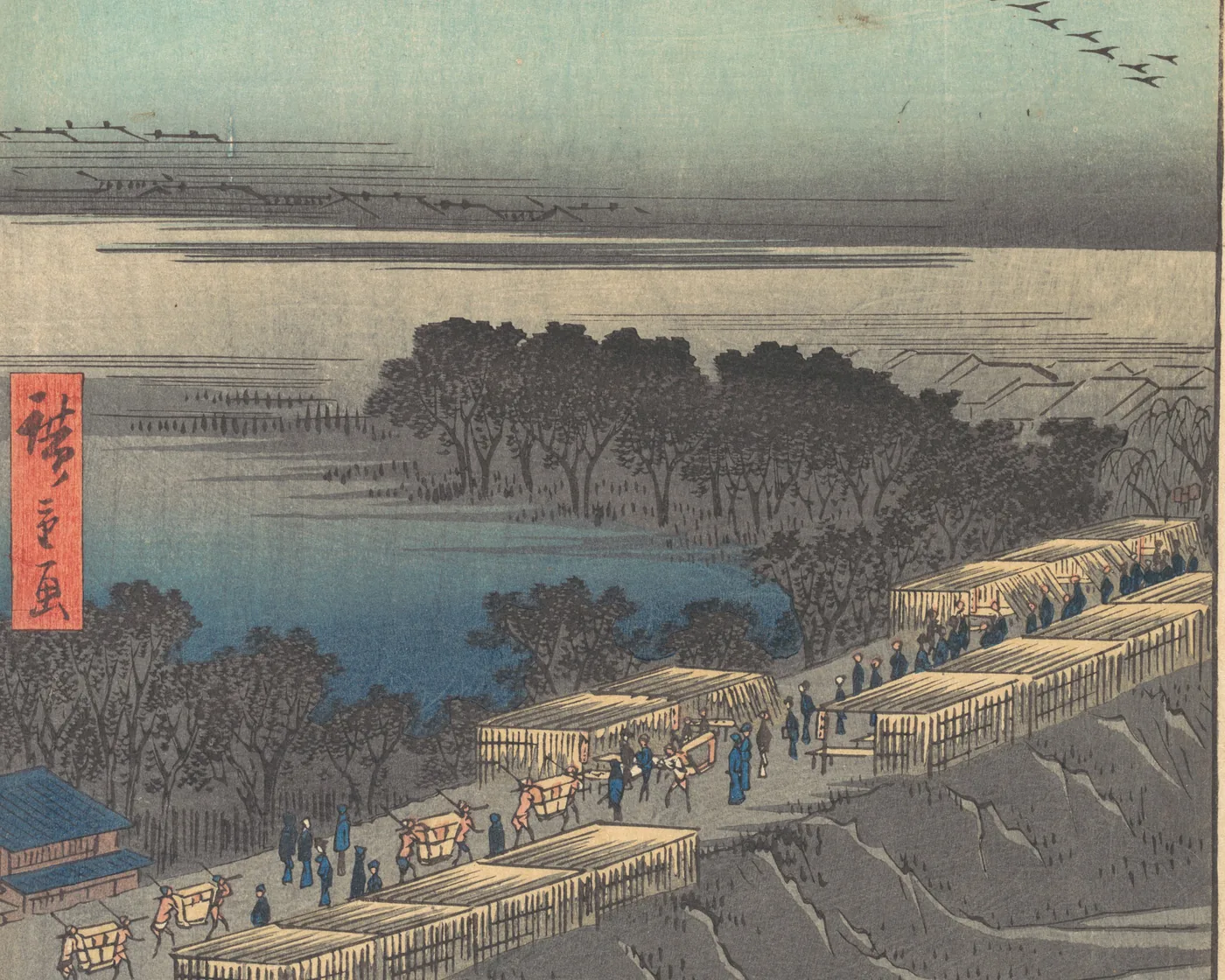
Header illustration: Utagawa Hiroshige, “Nihon Embankment, Yoshiwara”, from One Hundred Famous Views of Edo, 1857. The Metropolitan Museum of Art, public domain.