Hanakawado Park, Asakusa: Big Playground & Ubagaike Legend
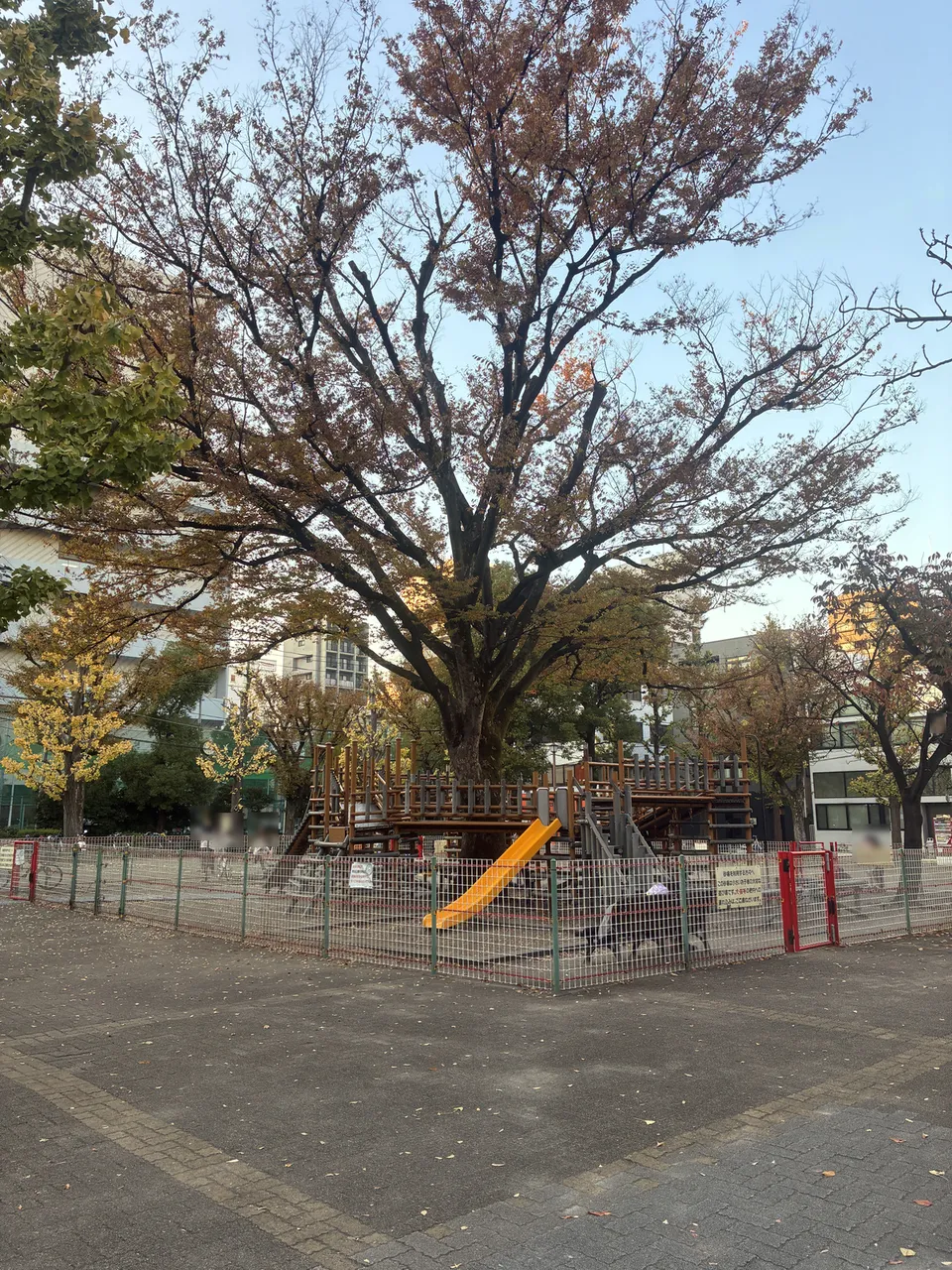
Hanakawado Park is a free neighborhood park about 250 m east of Senso-ji's Nitenmon gate. It has a large combination play structure built into a sandpit, a sports corner and a public toilet, which makes it a good break for families with small children. In one corner is the Ubagaike site, a Tokyo historic site with a dark Edo legend.
Quick facts
- Entry
- Free (public park)
- Play
- Large combination play structure built into a sandpit; sports corner (Taito City)
- Toilet
- Public toilet in the park (Taito City)
- Address
- North side 2-4-15 Hanakawado (Ubagaike, Sukeroku stone); south side 1-14-15 Hanakawado, across a road
- From Senso-ji
- About 250 m east of Nitenmon gate, 4 min (est.)
- From Asakusa Stn
- About 8 min (est.) from Ginza Line Exit 1
- Step-free
- Ginza Line Exit 1 has a street elevator; one step-free route down to Platform 1 (Tokyo Metro)
- Time needed
- 5 min for Ubagaike; 15–45 min with small children (est.)
“For small children, this is a big park. The play equipment is big too, and if you get tired from walking around, I think it's fine to stop here and rest for a while. I played here with my children many times myself.”
What is Hanakawado Park?
Hanakawado Park is a free neighborhood park on the east side of Senso-ji, next to Asakusa Elementary School. A road splits it into a north part at 2-4-15 Hanakawado, where the Ubagaike site and the Sukeroku poem stone are, and a south part at 1-14-15 Hanakawado (Taito City). It is not a sight in itself. It is where local families come to play, and it is a short walk from the temple’s quieter east gate, Nitenmon.
Is it good for small children?
Yes, as a break between sights. Taito City lists a large combination play structure built into a sandpit, plus a sports corner.
The park also has a public toilet (Taito City). There is no entry fee and nothing to book. The city’s park pages do not give opening hours. It is an outdoor park, so on a wet day see our rainy-day ideas instead.
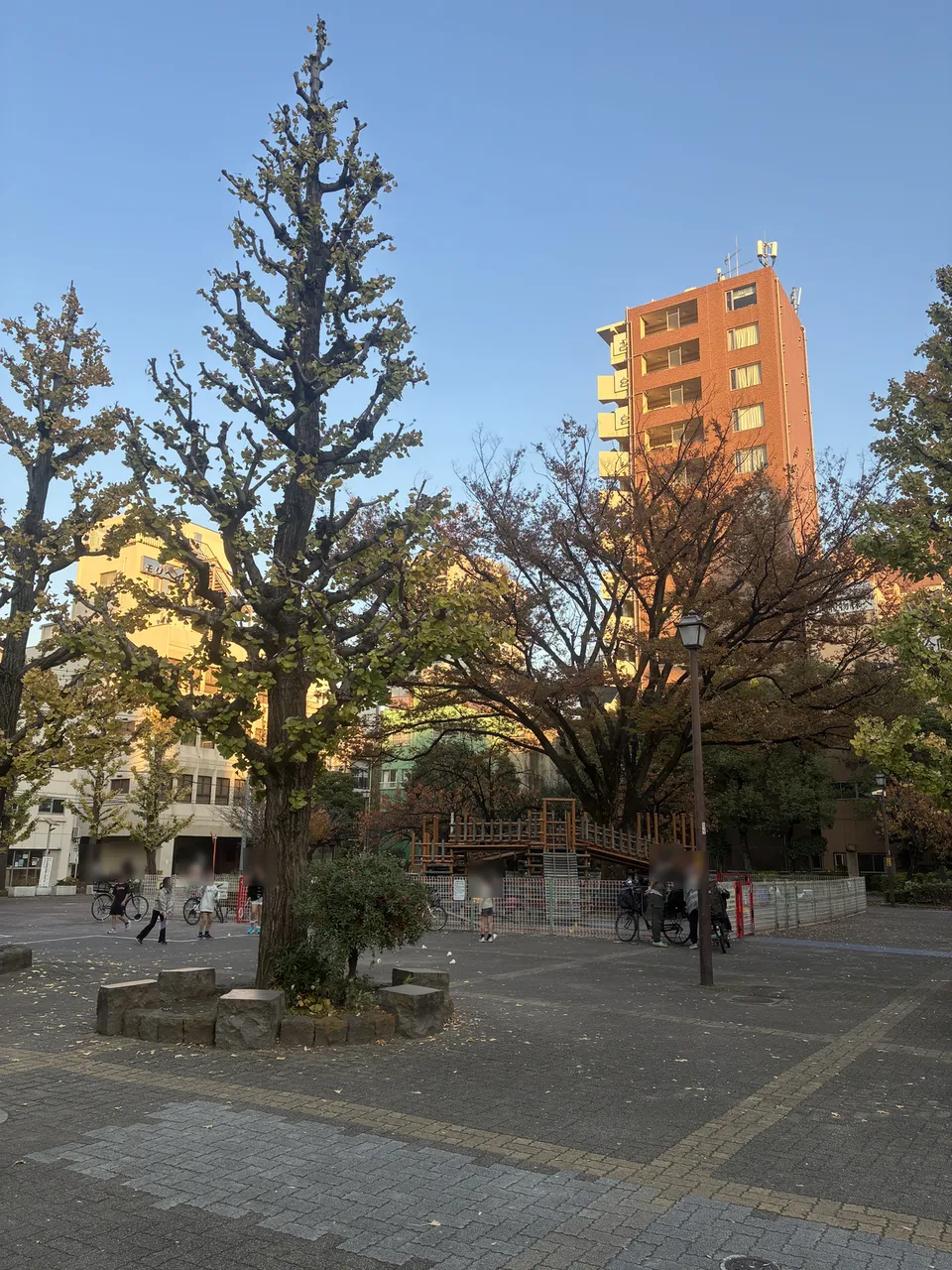 Hanakawado Park, November 27, 2026.
If you have a young family, it fits well after Senso-ji and before the river at Sumida Park, or as a stop before Hanayashiki, the small amusement park on the other side of the temple.
What is the Ubagaike site?
In one corner of the north part is Ubagaike (姥ヶ池, “the old woman’s pond”), a Tokyo-designated historic site. It was once a large pond that ran to the Sumida River. It was filled in during 1891 (Taito City), and the Tokyo Board of Education sign adds that the land became a park.
There is no water now. You find a dark stone marker carved 姥ヶ池之旧跡 (“old site of Ubagaike”), a stone lantern and a sign in Japanese and English, in a small planted corner. The sign gives two dates: landmarked in 1939, designated in 1955.
The legend behind the name is one of the darker stories in Asakusa, tied to a stone pillow kept by Myoon-in, a sub-temple of Senso-ji. An old woman lived with her daughter in a lone house on the Asajigahara moor. The daughter brought travelers home, and the old woman killed them by striking their heads with the stone pillow.
One night the daughter took a traveler’s place and was crushed under a great stone hung from the ceiling. Grieving and sorry for what she had done, the old woman threw herself into the pond, and the villagers called it Ubagaike (Taito City; Tokyo Board of Education sign).
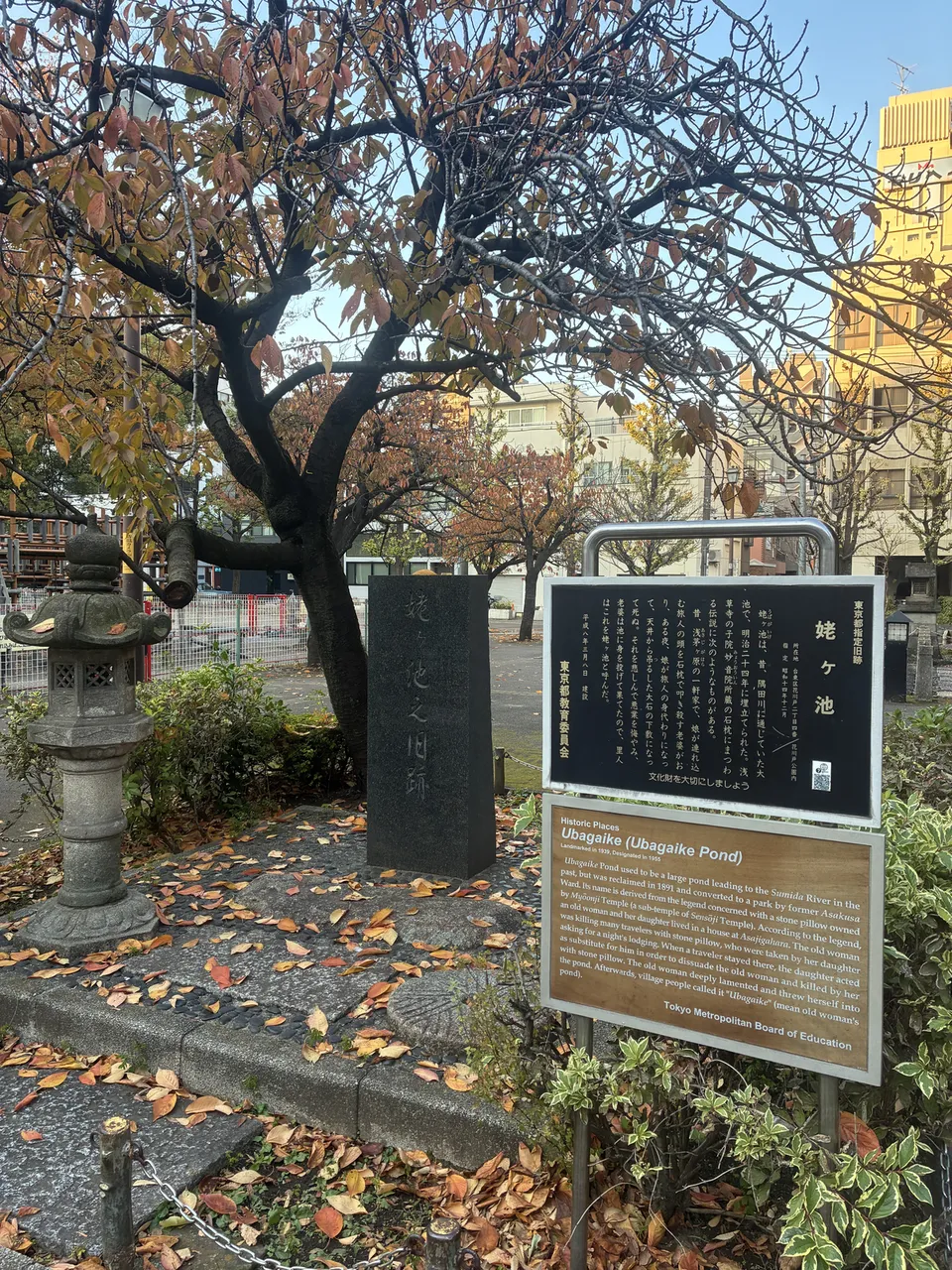 Ubagaike, Hanakawado Park, November 27, 2026.
It takes about five minutes to see. In late November the trees around the marker turn red and brown.
What else is in and near the park?
In the north part, the Sukeroku poem stone (助六歌碑) carries a poem written by the kabuki actor Ichikawa Danjuro IX. It was first set up in 1879 at a temple in what is now Kiyokawa, fell in the 1923 earthquake and lay buried for a while; after it was found, it was set up again here (Taito City). Sukeroku is one of the Ichikawa family’s famous kabuki plays.
Outside the park, a short walk away at 2-11-13 Hanakawado, Kuhonji temple has a large Buddha statue (daibutsu) listed as a Taito City cultural property. Hanakawado was a footwear town, and the temple has rebuilt a rare jizo statue that wears shoes (Taito City).
Getting there
The north part of the park, with the Ubagaike site, is at 2-4-15 Hanakawado; the south part is across the road at 1-14-15. The easiest way is through Senso-ji: leave by Nitenmon, the east gate beside the main hall, and walk about 250 m east (est.). Walking straight from Ginza Line Exit 1 takes about 8 minutes (est.); that exit has a street elevator, and Tokyo Metro lists one step-free route between the street and Platform 1. For the other lines, see Asakusa Station.
Nearby
Nitenmon and Asakusa Shrine are back to the west. To the east is the river and Sumida Park; to the north, the Oku-Asakusa walk passes this way on its return. More: Asakusa travel guide.